

 Student Login

AI Skills for Managers in 2027: What Employers Want Beyond Prompt Engineering
Oct 26, 2026With prominent tech leaders such as Sam Altman, Dario, and Geoffrey Hilton predicting AI-related job displacement in the near future, learning AI skills is becoming indispensable for experienced managers and senior executives to stay relevant, as organisations are moving beyond AI experimentation.
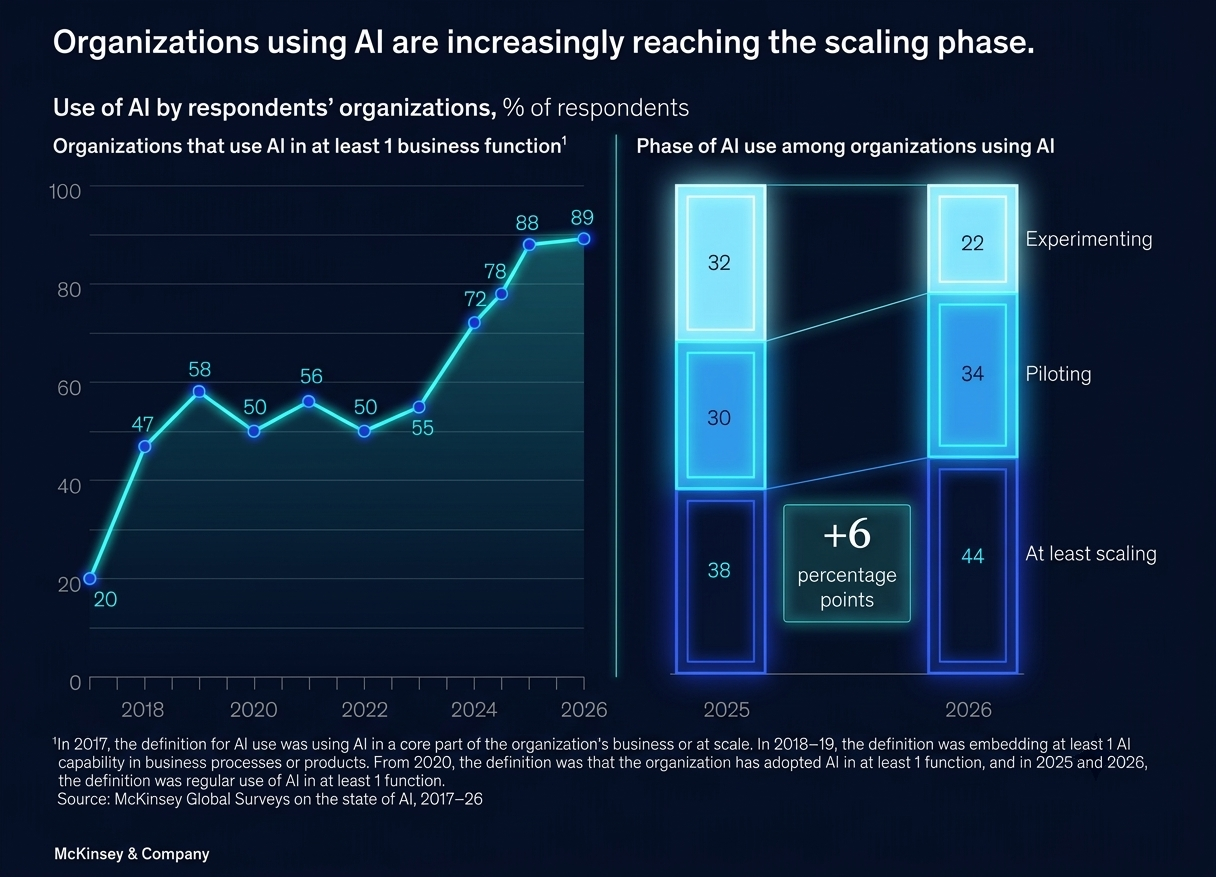
AI is already helping managers plan projects, analyse business performance, allocate resources, manage teams, and make strategic decisions faster. Interestingly, the use of AI is moving from experimentation to integration into everyday operations, which is correspondingly impacting the skills managers are expected to have.
According to Diana Scott, US Human Capital Center Leader at the Conference Board, AI is fundamentally transforming what it means to be an effective leader. She says success for top-tier leaders will depend more on guiding teams through change, building trust, and rethinking how work gets done rather than managing tasks.
Yes, prompt engineering is useful knowledge, but it is not sufficient. In the future, recruiters will likely give hiring priority to the managers who can identify meaningful AI use cases, decode AI-generated insights, evaluate risks, redesign workflows, and deliver measurable business outcomes by managing AI-assisted teams.
While AI skills matter, organizations that rely too much on the broader leadership capabilities needed to turn the technology into meaningful business value. A clear indication for managers in this context is to understand what intelligent machines can do as well as question AI-generated recommendations, how to validate their outputs, and identify the areas where human judgment matters.
Global Statistics That Validate Why AI Skills Matter for Managers
AI skills are instrumental for managers to stay relevant in their job or improve their employability as recruiters in future are to prioritise managers skilled in apt use of intelligent technology. The following global stats accentuate the significance of AI skills for managers.
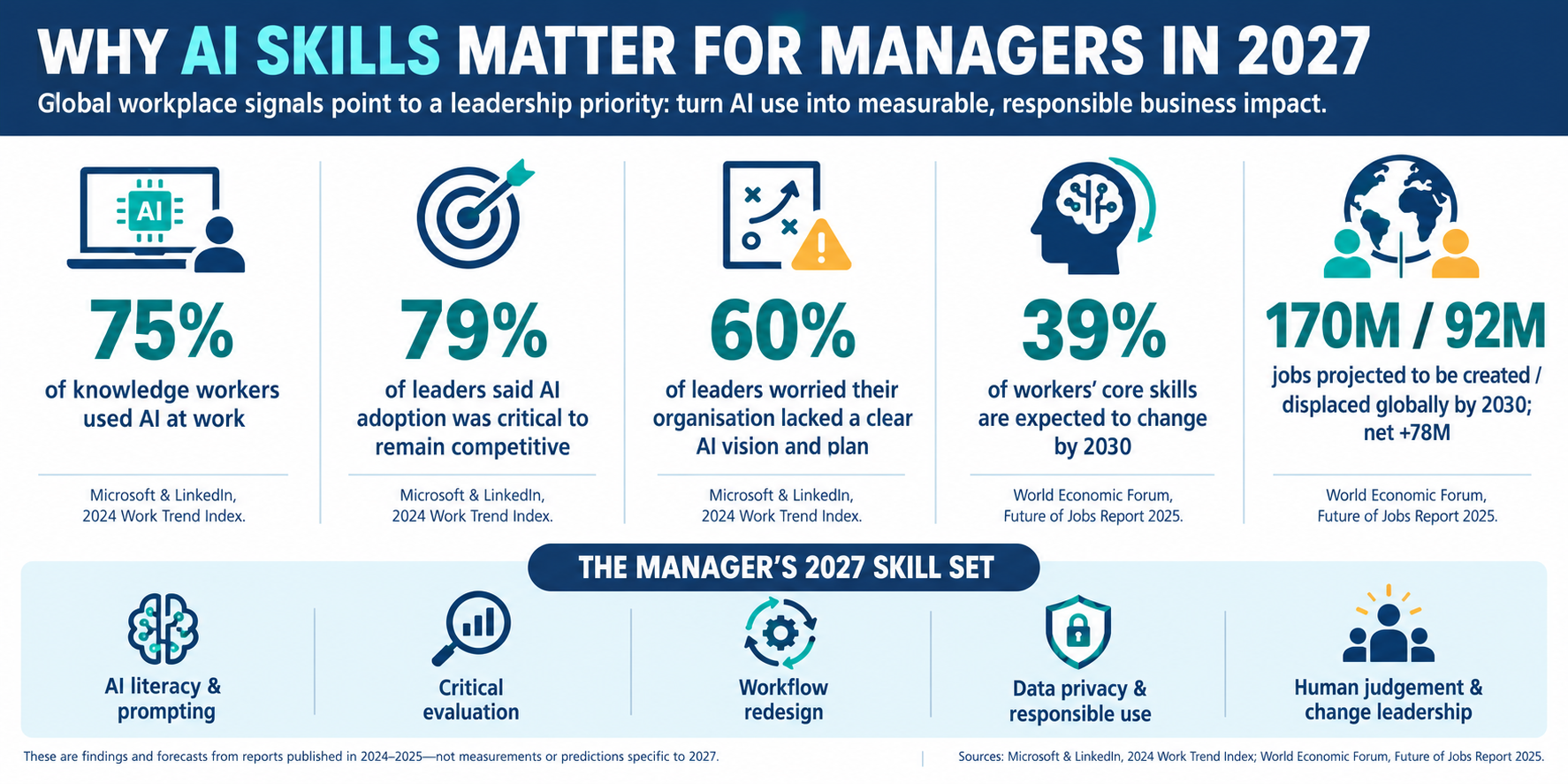
- According to a Gartner Enterprise Study, 73% of highly productive enterprise AI users are managers or executives, rather than individual contributors. Managers are carrying what is viewed as the major portion of the strategic workload.
- The McKinsey State of AI Global Survey indicates that 47% of mid-level managers and individual contributors experience AI-related workflow strains, compared to only 31% of senior executives.
- Gartner predicts that by 2027, 50% of enterprises lacking a people-centric AI strategy will lose their top AI talent. The responsibility to build this supportive environment rests directly on front-line managers.
- Comprehensive labor market data analyzed by the PwC AI Jobs Barometer reveals that jobs that require specific AI skills draw a staggering 62% average wage premium.
- Microsoft workplace insights show that 66% of business leaders flatly state they would not hire someone who lacks foundational AI literacy.
Why do AI skills matter for managers?
AI is a vital technology for managers and experienced professionals. Ignoring its rising popularity and adoption in companies worldwide would be tantamount to career suicide. In fact, the technology is evincing a tectonic shift from rigid legacy software and rule-based automation of repetitive tasks to autonomous generative systems.
Under such circumstances, managers can’t afford to lose their relevance to AI. In fact, managerial roles are already shifting from supervising individual tasks to coordinating people, data, automated systems, and business processes due to AI. Managers can’t rely on the mainstream hunch of deciding which tasks or activities to prioritize. They need to decide which activities or tasks to automate, which ones require human supervision, and how AI investments can help fulfill business goals.
Suppose a marketing manager is using AI to analyse customer feedback, identify campaign trends, and generate content of different types. However, the manager is still expected to use his human insights to factually verify claims, interpret customer sentiment, and decide which AI-suggested recommendations deserve investment. In another example, suppose an operations manager is using AI to forecast demand or identify bottlenecks. AI assists in the prediction, but managers must understand data quality, financial implications, and outcomes of inaccurate predictions to effectively turn those forecasts into insightful decisions.
Reasons AI skills are necessary for managers in 2027
AI is spearheading almost everything that is considered a linchpin of organizational growth, be it boosting workforce productivity, improving customer experience, streamlining operations and supply chain, and driving faster innovation. Here are the top reasons why developing AI skills matters for managers in 2027.
AI is moving beyond content generation
AI is no longer limited to generating content in different variations. Companies are exploring AI systems that can carry out tasks in different steps, retrieve information, interact with business applications, and support workflow automation.
Productivity must translate into business value
Managers are now expected to have strong AI skills that enable them to measure whether intelligent machines reduce costs, improve service quality, help decision-making faster, or boost revenue. These AI-skilled managers are what employers will seek in the future.
Risk management is becoming a leadership responsibility
Managers with AI skills can efficiently handle risk management tasks like privacy, cybersecurity, intellectual property, bias, accuracy, and regulatory compliance. They are not something that can be addressed by technical teams alone.
The main point to understand is that AI literacy is becoming part of management competence. Top-tier Managers do not necessarily need to build sophisticated machine-learning models, but they should know how to select, evaluate, govern, and apply AI tools responsibly.
AI is introducing a radical change in how work gets done faster, thus forcing companies to rethink how decisions are made, responsibilities are shared, and performance is measured to ensure the internal structures support new ways of working.
Top AI skills managers should learn in 2027
AI and automation are both rapidly changing the working mechanisms of the global business landscape. Data-backed decisions are made faster, leading to prompt execution of solutions that would have taken longer had they been theorized and conceived using traditional approaches.
Overlooking AI penetration into the business, professional, and personal life of humans would be a mistake no manager today can commit. So, as a manager, what AI skills should you learn? This section features an exclusive list of top AI skills managers should learn in 2027, which will hopefully help them in their career growth beyond 2027. It is also advised to keep abreast of AI trends, considering that what AI skills you learn today may be obsolete in the next couple of months or a year, given the rapid development of intelligent machines.
AI literacy and tool evaluation
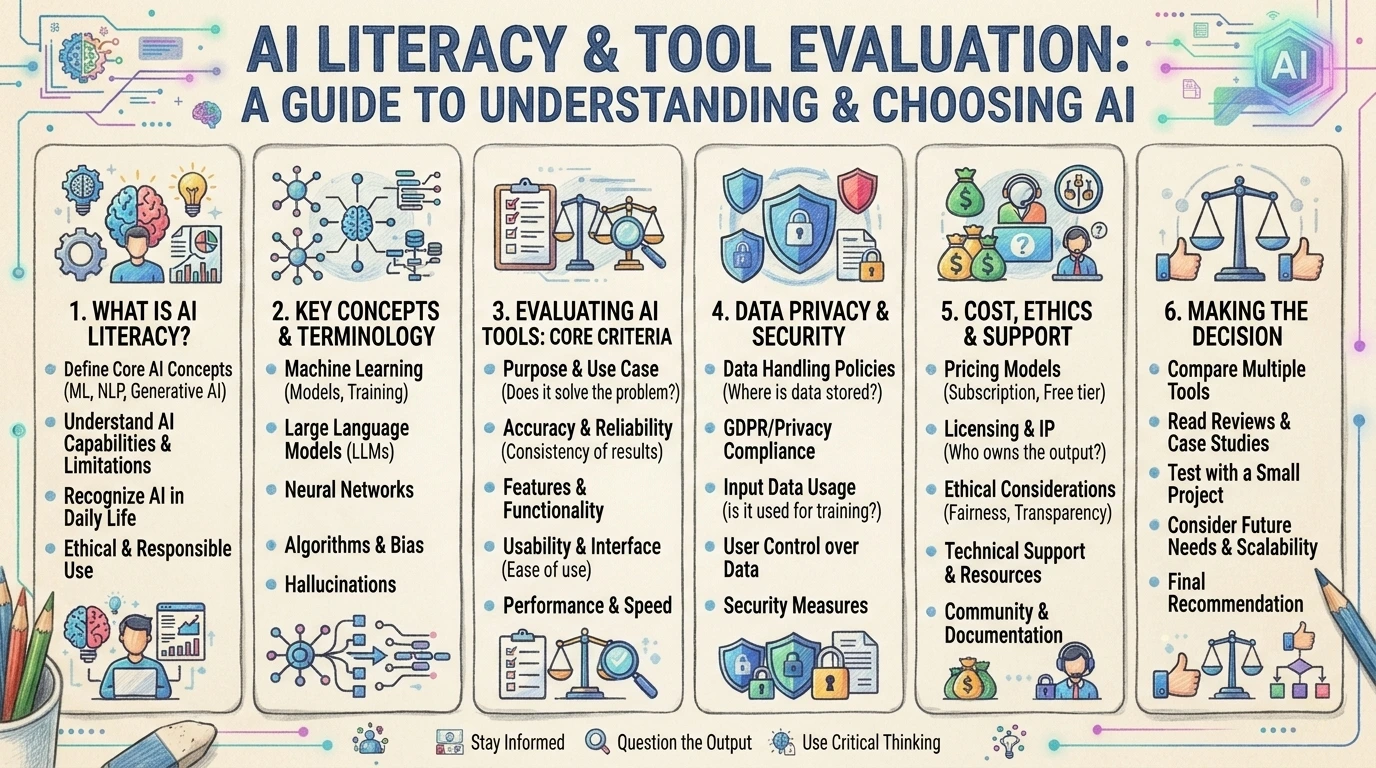
The meaning of AI literacy is not just eliciting a response from a chatbot through prompts. It is understanding how the systems work at a practical level, what they are good at, and where they can make mistakes. For example, OpenAI long ago confessed in its press release that its AI models are sycophantic, thus making it very necessary for senior leaders to evaluate these tools based on business needs rather than popularity.
AI literacy also means understanding the differences between generative AI, predictive analytics, machine learning, and AI agents. Basically, if you are a manager, learning how to assess AI capabilities, choose relevant tools, and explain the value of AI tools to non-technical stakeholders is what can make you employable in the eyes of potential employers.
Data literacy and analytical thinking
Trusting AI-generated conclusions without understanding the underlying data would only mean reaching decisions lacking substance. Having said that, data literacy plays an instrumental role in helping you assess the accuracy, relevancy, and reliability of information generated by AI.
Managers must have the skills to comfortably interpret dashboards, understand basic statistics, identify correlation versus causation, and question assumptions behind AI-based predictions. Learning data literacy and analytical thinking can make a manager skilled in how to turn AI-generated insights into sound decisions, rather than accepting automated conclusions at face value.
Workflow automation and AI agent management
Managers should learn workflow automation and AI agent management as a skill to design processes that are trustworthy, coordinate multi-agent teams, and scale operations without inflating the manual labor costs. These skills are beyond prompt engineering, and managers, therefore, need to identify appropriate processes and decide when a task should be escalated to a human.
The managers also need to understand that if every task is put on automation, it may invite some risks if an agent deviates from the pre-guided instructions or acts on inaccurate information. Therefore, managers must learn how to redesign repetitive workflows, coordinate AI-assisted processes, and improve productivity without compromising quality.
Critical thinking and AI output validation
Senior and experienced working professionals like managers must learn critical thinking and how to validate AI output because artificial intelligence still suffers from hallucinations. These skills are important to spot erroneous AI-generated outputs, missing context, and avoid blindly trusting automated results that could correspondingly hurt intelligent decision-making processes. High-impact decisions should be validated through a human review process rather than being approved automatically. Managers must learn to use AI to support their thinking, not replace it, and remain accountable for the quality of the final decision.
Strategic thinking and AI opportunity identification
When Elon Musk bought Twitter (rebranded now as X) for $44 billion, it was a classic example of strategic thinking in play. Strategic thinking and the ability to identify AI opportunities are key skills managers should learn in 2027. Instead of asking the exact use case of AI, managers should ask which business problems are worth solving, whether AI is conducive to solving them, and whether it will drive realistic improvement. The right use case depends on the quality of available data, implementation costs, operational risks, and anticipated business value. Therefore, managers need to prioritise AI uses based on strategic relevancy, ROI, and alignment with organizational goals.
AI governance, ethics, and risk management
The value of these skills is monumental for managers, in light of how compliance regarding AI governance, ethics, and risk management has become extremely important for organizations to stay relevant and trustworthy in business. Managers must learn data privacy, confidentiality, cybersecurity, bias, explainability, intellectual property, and accountability to be able to responsibly use artificial intelligence.
Any oversight in these areas can negatively influence consequential decisions when AI is used in recruitment, evaluating performance, healthcare, customer profiling, etc. An understanding of applicable legal and regulatory requirements is also necessary for managers. Basically, a manager who supports AI adoption while safeguarding customers, employees, business data, and organisational trust is the resource future employers will want.
Change management and workforce development
Learning change management and workforce development skills enables managers to explain the cause of a change, identify training needs, address employee concerns, and create opportunities for teams to experiment with AI safely. Managers who can build AI confidence, support reskilling, reduce resistance to change, and help teams adopt better working practices are what employers will likely hire.
Human-centred leadership and communication
A manager can become a great leader if they exercise workplace active listening techniques, which lay the groundwork for solid human-centered leadership. In the age of AI, building human-centric leadership is now a much more essential requirement than it was years ago. Firing employees under the pretext of AI-backed rationalisation is not symptomatic of technological competence.
Managers must learn soft skills regarding negotiation and conflict resolution, and showcase the ability to communicate complex changes clearly. A manager who understands how to combine technological expertise with sound judgment, emotional intelligence, and effective people management will become a useful resource for employers.
AI performance measurement and ROI analysis
The underlying meaning of the ‘AI performance measurement and ROI analysis’ skill is asking whether spending money and time on an AI tool actually helps the business, or whether money spent on it is lost. Therefore, for a manager, it is essential to evaluate AI adoption by comparing AI implementation costs with improvements in productivity, quality, speed, customer satisfaction, and risk mitigation. Analysis should be made on metrics including processing time per case, error rates, customer resolution time, cost per transaction, forecast accuracy, or time spent by employees on higher-value tasks.
Adaptability and continuous learning
The thing with developing AI skills is that you have to stay updated with the latest trends in the technology. Besides, AI tools, capabilities, risks, and practices maintained by organisations undergo rapid changes. Therefore, managers should be able to test new approaches, learn from failed experiments, review new guidance, and update their skills as business requirements shift. Continuous learning doesn’t mean following every new tool. It is understanding whether new developments in AI drive meaningful improvements.
Comparative analysis of AI skills that employers want beyond prompt engineering
Though the value of prompt engineering has not diminished, considering clear prompts is always helpful to elicit appropriate responses from AI systems. However, it is just one part of effective AI use. Employers today need evidence that managers can apply AI to business problems, manage risks, and deliver productive results.
|
Skill area |
What managers should be able to do |
Evidence of competence |
|
Prompt engineering |
Give clear instructions, context, constraints, and output requirements. |
Produce consistent, relevant AI-assisted work. |
|
AI literacy |
Understand AI capabilities, limitations, and suitable applications. |
Explain why a particular tool fits a business task. |
|
Data literacy |
Interpret data and question analytical conclusions. |
Validate a report or forecast against source data. |
|
Workflow automation |
Design AI-assisted processes with appropriate controls. |
Demonstrate a repeatable workflow with human checkpoints. |
|
Critical thinking |
Check claims, calculations, assumptions, and recommendations. |
Provide a verified decision brief. |
|
AI governance |
Identify privacy, bias, security, and compliance risks. |
Create a practical risk checklist and review procedure. |
|
Strategic judgement |
Prioritise high-value AI opportunities. |
Develop a business case linked to organisational goals. |
|
Change management |
Prepare teams for new AI-enabled processes. |
Deliver a training or adoption plan. |
|
Performance measurement |
Evaluate productivity, quality, cost, and outcomes. |
Present baseline and post-implementation metrics.. |
|
People leadership |
Coach employees and maintain accountability. |
Show how AI supports rather than weakens team performance. |
How Managers Can Use AI Skills Across Business Functions
The ability to use AI skills across business functions is what makes a manager efficient and results-driven. In light of how smart machines are introducing radical changes to the way businesses work, it’s high time managers learned to maximize AI skills to drive organizational growth.
|
Function |
Practical AI Applications |
Skills That Matter Most |
|
Marketing |
Customer research, campaign analysis, content testing, audience insights |
Data literacy, output validation, brand judgement |
|
Human resources |
Drafting job descriptions, analysing survey themes, workforce planning |
Bias awareness, privacy, human-centred judgement |
|
Finance |
Forecasting support, variance analysis, report preparation, anomaly identification |
Analytical thinking, financial judgement, data validation |
|
Sales |
Account research, lead prioritisation, proposal preparation, sales forecasting |
AI literacy, communication, strategic thinking |
|
Project management |
Meeting summaries, risk tracking, schedule analysis, status reporting |
Workflow design, verification, stakeholder management |
|
Customer service |
Ticket classification, response drafting, knowledge retrieval, escalation support |
Quality control, customer empathy, governance |
|
Senior leadership |
Scenario analysis, strategic research, decision support, productivity measurement |
Strategic judgement, ROI analysis, responsible AI governance |
AI Certifications and Learning Resources for Managers
Certifications basically provide structured learning, but their main use is when they come with practical projects. The reason is that practical learning is what gives you a realistic understanding of AI fundamentals. Besides, managers should choose learning paths that align with their responsibilities. There is no meaningful use of collecting credentials when you don’t apply the knowledge.
|
Learning area |
Useful learning resource |
What to focus on |
|
AI fundamentals |
Microsoft Learn |
AI concepts, responsible AI, and business applications |
|
Generative AI fundamentals |
Google Cloud Skills Boost |
Generative AI capabilities, limitations, and practical use cases |
|
AI and data strategy |
IBM SkillsBuild |
AI fundamentals, data literacy, and workplace applications |
|
Responsible AI and governance |
NIST AI Risk Management Framework |
Risk identification, oversight, evaluation, and accountability |
|
Analytics and decision-making |
Business analytics courses and hands-on dashboard projects |
Data interpretation, forecasting, and evidence-based decisions |
|
Workflow automation |
Approved enterprise automation tools and their official training materials |
Process mapping, integrations, permissions, exception handling, and monitoring |
|
Change management |
Management development programmes and workplace projects |
Communication, reskilling, adoption, and team leadership |
|
Agentic & Gen AI |
Careerera |
Gain expertise in modern AI systems. |
How Managers Can Measure the Business Value of AI Skills
One of the best ways managers can ensure the business value of AI skills is measured is to look beyond the vanity metrics like login counts or prompts sent. Instead, track workflow integration by measuring how employees, output quality, and cycle times.
An ideal framework managers should adopt to measure the business value of AI skills is to determine the financial outcomes in terms of revenue uplift, margin improvements, or total cost of ownership. Also, review health metrics of AI tools in terms of hallucination rates, latency, and output quality. Follow the tabulated guide below.
|
Business objective |
Possible KPI |
What it measures |
|
Improve productivity |
Average time per task. |
Whether work is completed more efficiently. |
|
Reduce operating costs |
Cost per transaction or case. |
Whether the process costs less to operate. |
|
Improve quality |
Error rate or rework rate. |
Whether outputs meet required standards. |
|
Improve customer service |
Resolution time and customer satisfaction. |
Whether customers receive faster, better support. |
|
Improve forecasting |
Forecast error. |
How closely predictions match actual outcomes. |
|
Improve employee experience |
Employee feedback and adoption rate. |
Whether the new workflow is usable and accepted. |
|
Reduce risk |
Policy violations, incidents, and unresolved exceptions. |
Whether appropriate controls are working. |
|
Improve decision-making |
Decision turnaround time and documented decision quality. |
Whether managers can reach well-supported decisions more effectively. |
Winding Up
AI skills for managers will no longer be restricted to just prompt engineering. The future is beckoning a shift in hiring where employers will place importance on managers who can evaluate AI tools, decode data, automate workflows, validate AI-generated outputs, manage risks, lead teams through active listening techniques and change, and measure business performance in relation to AI skills.
What seems on the horizon is the way of combining technological literacy with managerial judgment. Far from being AI researchers or software engineers, managers need to understand where AI fits into their organisation, where human supervision is necessary, and how to ensure that technology supports sound decisions and meaningful business results.
For managers, it is necessary to select one relevant business problem, develop a relevant AI-assisted workflow, measure its outcomes, and document the lessons learned. Since businesses around the world are moving beyond AI experimentation, managers must ensure prudent application of the right AI skills in alignment with business objectives and expected ROI.