

 Student Login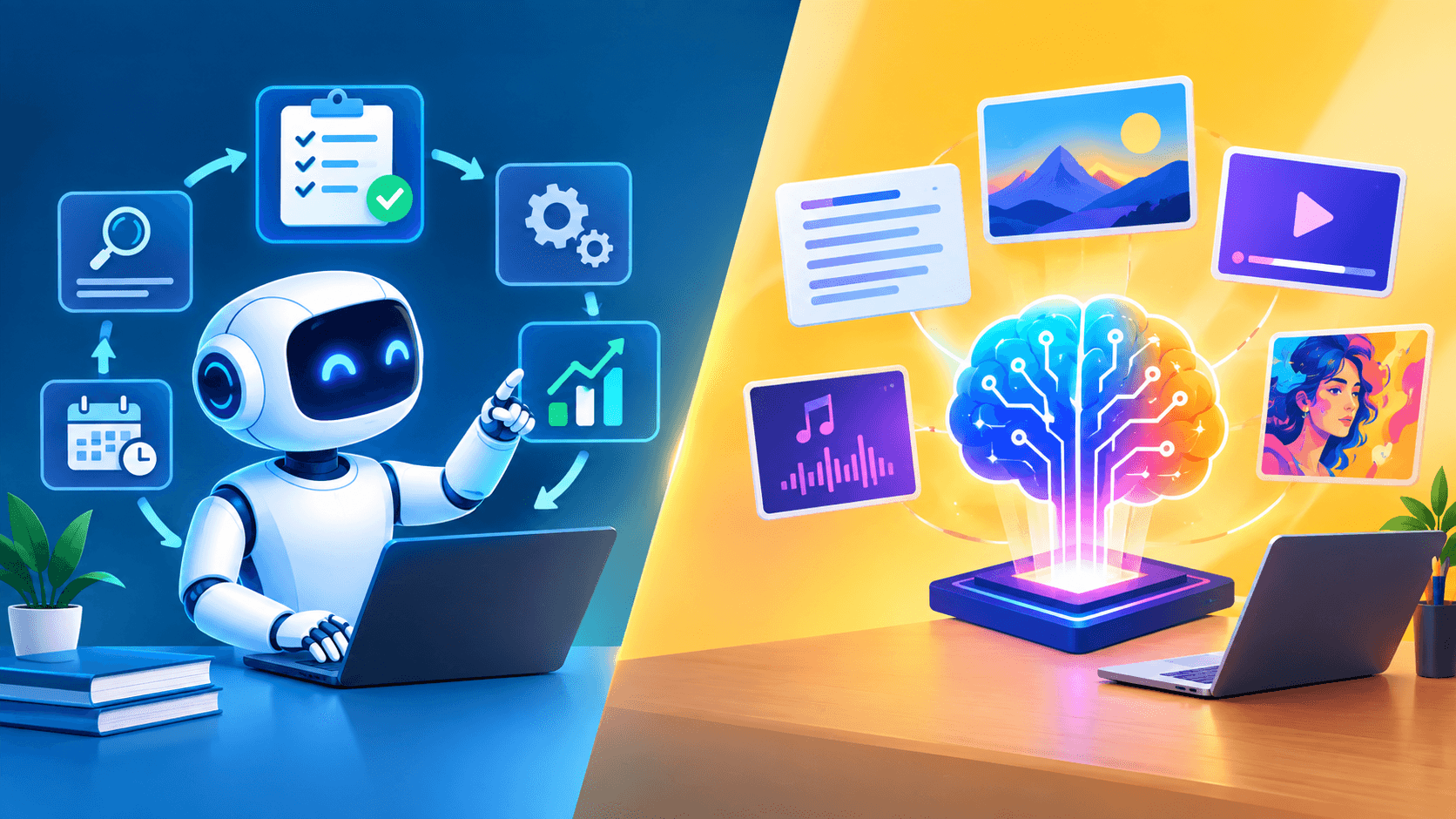
Agentic AI vs Generative AI: Key Differences, Use Cases, and Future Skills
Oct 7, 2026Generative AI and Agentic AI are two of the most prominent trends in modern AI development. The former is essentially about creating contents such as text, images, computer code, audio files, and videos. The latter is concerned with performing tasks and reaching certain goals with minimal human intervention. Businesses are turning to AI for content creation, automating various processes, providing customer support, writing computer code, and making decisions. This trend is critically important to distinguish generative and agentic AI. The key difference is that generative AI is usually triggered by some user input for a specific purpose while agentic AI can be trained to achieve a particular goal and perform all the necessary steps to accomplish it.
What is Generative AI?
Generative AI is a concept of AI models and systems that can be trained to generate text, images, video or code through learning from large sets of existing data. By itself, Generative AI mainly focuses on generating content in response to a user’s request, rather than performing a particular workflow.
- Trained on large sets of data using deep learning methods.
- It can produce creative works of different types, including text, design, audio, etc.
- It utilises user prompts and patterns learned to generate content.
- Examples would include ChatGPT, DALL·E, and Gemini.
What is Agentic AI?
Agentic AI is much more than a language model, as it can comprehend directions, have objectives, formulate strategy, make decisions, and adjust its strategy according to the outcomes of previous attempts.
- Makes decisions and takes actions based on reasoning and planning.
- Can utilise tools, perform web searches, or carry out other tasks.
- Can involve multiple steps of decision-making, evaluation, and feedback.
- Can use foundation models such as large language models together with tools, workflows, and other system components.
Agentic AI vs Generative AI: Key Differences
|
Factor |
Generative AI |
Agentic AI |
|
Main purpose |
Creates content and information |
Completes tasks and achieves goals |
|
Working style |
Prompt and response |
Goal, planning, action and feedback |
|
Autonomy |
Generally limited |
Generally higher |
|
Planning |
Usually limited |
Central capability |
|
Tool usage |
Optional |
Often uses tools and external systems |
|
Multi-step tasks |
Can assist with them |
Designed to handle them |
|
Decision-making |
Mainly provides outputs or suggestions |
Can make decisions within defined boundaries |
|
Output |
Content, answers or analysis |
Completed task or business outcome |
|
Human role |
Often provides instructions and reviews output |
Can supervise, approve or intervene when needed |
How Generative AI and Agentic AI Work
Generative AI and Agentic AI are types of AI that use AI models to perform specific types of tasks. Generative AI tends to complete tasks that are based on producing a result given a prompt, whereas, Agentic AI uses AI models to plan and carry out numerous steps to complete a task.
How Generative AI Works
Generative AI works by using a prompt/response mechanism.
- Input: A prompt/question/instruction is provided by the user.
- Processing: The model processes the prompt using the pattern recognition capabilities that have been trained to detect during training.
- Generation: The model generates a response based on the prompt.
- Output: The response/output is provided to the user.
For example, if you give a prompt "Summarise this financial report", Generative AI will go through the report and summarise it for you.
Generative AI can also be combined with Retrieval-Augmented Generation (RAG) which is an AI framework that improves large language model (LLM) accuracy by fetching facts from external knowledge bases before generating a response. This makes combining with proprietary data much easier, especially when using this type of data. With this approach, the system retrieves relevant information from databases, company documents or other information sources. This information is then provided as context for the prompt which the Generative AI will use to provide a response. This allows the use of language models while leveraging private data.
Basic flow:
Prompt → AI Model → Generate → Response
Therefore, Generative AI is primarily focused on generating or transforming information in response to an input.
How Agentic AI Works
Agentic AI takes a goal or input, and infers a set of steps that should be taken to achieve it. Rather than producing a response, it can employ a variety of tools, take actions, evaluate and improve the results, until the task is completed.
The basic processing flow is:
- Understand the goal: Determine what the user wants to achieve.
- Plan: Break the goal down into smaller, achievable tasks and determine the order in which to perform them.
- Use tools: Interact with a database, API, App, search or other tools to retrieve information or perform certain actions.
- Take action: Based on the plan, perform the individual steps.
- Evaluate: Check if the performed actions lead to the desired outcome.
- Continue or adjust: If the actions did not achieve the goal, continue with other steps or adapt the approach.
- Complete the goal: Repeat until the process is complete or requires human interaction.
For example, for a goal of processing a customer's product return, an agent can retrieve the customer's order, check the return policy, confirm eligibility, initiate the return process, update the system and customer.
Basic flow:
Goal → Plan → Use Tools → Act → Evaluate → Continue/Complete
The key difference is that Generative AI produces an output, whereas Agentic AI uses the capabilities of AI to determine and carry out the actions that are needed to achieve an outcome.
Generative AI and Agentic AI Combined
The two approaches can also be combined, with an agentic system using Generative AI to assist one or more steps, such as analysing data or generating a response, whilst the agent manages the larger workflow.
Example:
Customer request → Agent plans the task → Generative AI analyses/generates information → Agent uses tools → Agent takes action → Result is checked → Task completed
In this case, Generative AI provides the generation and analysis capabilities, while Agentic AI manages the individual steps in order to complete a task.
Business Use Cases for Generative AI and Agentic AI
Generative AI and Agentic AI are both used by businesses, but serve different purposes.
Generative AI is used to help people create, summarise, analyse, and transform information. Agentic AI can plan, make decisions, use multiple tools, and perform various tasks to accomplish a goal. Many businesses use both types of AI.
Generative AI Use Cases
- Content Creation
Generative AI can help a business create various types of content quickly. It can be used to write articles, emails, advertisements, product descriptions, training material, and technical documents. It can also summarise, translate, and rewrite existing content for different audiences, and humans can review content to ensure it is correct and appropriate.
- Customer Support
Generative AI can help customer service representatives answer customer questions and create quick responses. It can help by
- Answering customer questions
- Summarising conversations
- Writing knowledge-based articles
- Providing support through chat-bots
This can allow a business to provide faster and more consistent customer service.
- Financial Services
Financial organisations can use generative AI to work with large amounts of financial information. It can help by
- Summarising financial reports
- Analysing financial data
- Preparing communications for customers
- Researching market information
- Explaining financial information
This can help financial professionals be more efficient with their work.
- Human Resources
Human resources departments can use generative AI for many of their routine tasks. For example, it can:
- Create job descriptions
- Summarise resumes
- Answer questions about company policies
- Create onboarding materials
- Prepare training content
- Summarise performance reviews
This can help reduce the workload of the human resources department.
- Knowledge Management
Generative AI can help employees find and understand information pertaining to their company. This includes searching the company's documents, summarising reports, answering questions, and providing information from trusted internal sources. Many companies utilise Retrieval-Augmented Generation, which pulls information from the relevant documents, and uses that information to generate an answer.
- Legal and Compliance
Legal and compliance departments can use generative AI to work with legal documents and documents. It can help by
- Reviewing contracts
- Summarising laws and regulations
- Drafting policies
- Preparing business documents
- Searching large quantities of legal information
However, legal professionals should always review important legal documents.
- Product Design and Development
Product designers can use generative AI to develop and innovate new products. It can help by
- Generating product ideas
- Comparing different concepts
- Creating product requirements
- Summarising customer feedback
- Designing early prototypes
- Generating data for testing
This can help product designers bring products to market faster.
- Sales and Marketing
Sales and marketing professionals can use generative AI to create and personalise content. It can help by
- Creating advertisements and marketing campaigns
- Writing sales emails
- Personalising customer messages
- Preparing business proposals
- Summarising customer conversations
- Helping sales representatives prepare for meetings
This allows sales representatives to spend more time communicating with customers.
- Software Development
Developers can use generative AI to help with software development. It can help by
- Generating code
- Explaining existing code
- Finding bugs
- Creating documentation
- Generating test cases
- Suggesting improvements
Developers should always review and test any code that was generated by AI.
- Supply Chain
Generative AI can help supply chain managers understand information. It can:
- Summarise operational data
- Analyse supplier reports
- Create procurement documents
- Identify trends
- Explain supply chain issues
- Suggest possible solutions
This can help businesses make better and faster decisions.
Agentic AI Use Cases
Agentic AI is designed to take action and complete tasks, not just provide information. It can perform multiple steps and work with various business systems.
- Customer Service
Agentic AI can handle a customer request from start to finish. For example, it can:
- Identify the customer
- Check their account information
- Find the relevant company policy
- Process a return or update their account
- Schedule an appointment
- Send a confirmation to the customer
If the issue is complicated, it can transfer the case to a human representative.
- Cybersecurity
Cyber security teams can use Agentic AI to help identify and resolve threats. It can:
- Monitor security alerts
- Investigate suspicious activity
- Connect information from different systems
- Identify important threats
- Suggest solutions
- Perform approved security actions
Human cybersecurity experts can remain involved if the situation requires.
- Financial Services
Agentic AI can help organisations with various financial processes. It can be used for:
- Fraud detection and response
- Compliance monitoring
- Credit risk assessment
- Financial risk management
- Investment analysis
The AI can continuously monitor information and take approved actions as needed according to company policies.
- Healthcare
Healthcare professionals and administrators can use agentic AI to help with administrative and operational tasks. For example, it can:
- Schedule appointments
- Send patient messages
- Organise documentation
- Coordinate patient care
- Monitor relevant patient information
However, humans must remain involved with important medical decisions and sensitive healthcare activities.
- Human Resources
Agentic AI can help automate various steps in the recruitment process. During recruitment, it can:
- Screen candidates
- Schedule interviews
- Send emails
- Coordinate with interviewers
It can also help with employee onboarding, answer employee questions, and send requests to the correct HR system.
- IT Operations
IT professionals can use agentic AI to monitor computer systems and resolve technical issues. It can:
- Monitor systems
- Detect problems
- Investigate alerts
- Find possible causes
- Suggest solutions
- Perform approved fixes
This can help IT professionals quickly resolve issues.
- Manufacturing
Agentic AI can be applied to enhance the functioning of manufacturing professionals. It can be utilised to oversee the functioning of machinery and the production process, detect issues, and recommend or execute corrective measures.
For instance, it can alert the maintenance department of an impending machine malfunction that could disrupt the production process. This can subsequently result in increased production rates and improved product quality.
- Sales and Marketing
Agentic AI can help sales and marketing professionals with end-to-end customer engagement processes. It can:
- Identify and qualify leads
- Personalise customer messages
- Track customer interactions
- Recommend the next step
- Manage marketing campaigns
- Monitor campaign results
- Make approved changes to campaigns
This allows marketing and sales professionals to automate repetitive tasks.
- Software Development
Agentic AI can handle more involved software development tasks than generative AI. For example, an AI agent can:
- Understand the software requirements
- Write the code
- Run tests
- Find errors
- Fix the code
- Run the tests again
- Give the finished project to a developer for review
This can help developers complete complex tasks faster.
- Supply Chain
Agentic AI can help coordinate activities between suppliers, warehouses, inventory systems, and logistics providers. It can:
- Monitor inventory
- Identify possible supply issues
- Check supplier information
- Track purchase requests
- Coordinate logistics
- Suggest or perform approved purchasing actions
This can help businesses keep their supply chain operating smoothly.
- Workflow Automation
A major issue of agentic AI is to automate end-to-end business processes. An AI agent can collect information, make decisions based on business rules, use multiple software systems, and complete various steps without requiring a person at every stage. For example, they can be used for:
- Document processing
- Employee onboarding
- Procurement
- Customer service
- Supply chain management
Generative AI Skills: Content Creation, Text, and Data
Generative AI deals with the generation and analysis of content using Large Language Models (LLMs) and other AI methods.
- AI Literacy: Understanding how AI models work, its possibilities and limitations, and what mistakes it can make (like hallucination).
- Prompt Engineering: Writing clear instructions, providing the right context, and imposing restrictions to obtain the best results from AI tools such as ChatGPT, Gemini, and Claude.
- Data Skills (SQL and Analytics): Knowing how to work with data, extract the necessary information, and prepare it in the required format for processing by LLMs.
- AI Evaluation: Reviewing AI-generated AI results and checking for errors, hallucinations, bias, or safety issues.
Agentic AI Skills: Autonomous Execution and Systems
Agentic AI goes further in that it allows one to create independent AI capable of performing entire business processes with minimal or no human interaction. This requires knowledge of AI programming, APIs, and business logic.
- Python and APIs: Using programming language Python and APIs – tools that allow an AI agent to connect with external applications, software, services and carry out actions.
- Automation and AI Agents: Building AI agents and workflows where various tools, APIs, agents can work together to carry out entire business processes.
- Domain Knowledge: Know the domain (business or industry) in which an AI agent will operate – so you understand its needs, problems, and how business processes are organised.
Is Agentic AI Replacing Generative AI?
No, Agentic AI is not just replacing Generative AI. These are two separate technologies, and both have their own purpose.
Generative AI can generate content, ideas, summarise any information, and even write code. Agentic AI takes all of this one step further because using this technology you can plan, execute, make decisions, and perform other actions, including using various tools.
For instance, with Generative AI you can write a customer's email. However, with Agentic AI you get to make a step further and execute the whole process. The last technology will understand the request, get all the necessary information, create the email, send it to the appropriate systems, and make sure to file the following actions.
In conclusion, Agentic AI is not a substitute for Generative one, but rather an addition to it, because the latter is used in the former to accomplish bigger tasks. While Generative AI is used to create content in any type, Agentic AI makes sure that this content will serve its purpose.
Conclusion
Generative AI and Agentic AI have different but complementary applications, with the former concentrating on information generation and the latter on execution and operations. Therefore, the two can be combined to enhance the production of value and optimise business operations through automation.